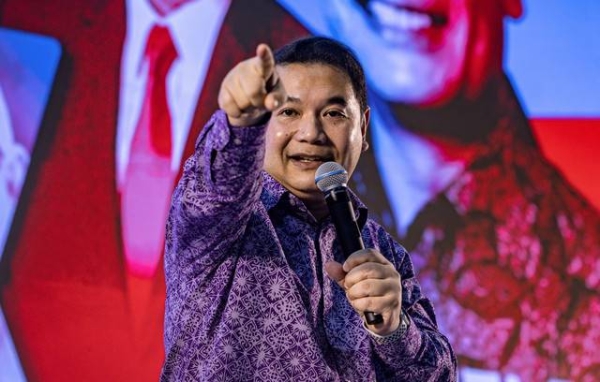
Rafizi Ramli is now attempting to reinvent himself as a principled whistleblower, a repentant insider who feels morally obligated to expose the government he once served. But Malaysians should understand exactly what they are witnessing.
This is not reform. This is not courage. This is not accountability. This is the familiar pattern of a politician who only finds his “voice” when he loses power, who only discovers “principles” when he is no longer in the room, and who only fights for the people when the people no longer listen to him.
His sudden awakening is not a public service. It is a struggle for political relevance. Everything he is saying today emerges from the same emotional well that has shaped his political behaviour for more than a decade.
When he is at the top, he is silent. When he is sidelined, he protests. When he wins, he cooperates. When he loses, he denounces. It is a cycle that has repeated itself so consistently that only those who want to be fooled still call it idealism.
The truth is that much of the damage he now loudly condemns comes directly from his own advice, his own decisions and his own failed projects. PADU is the clearest example. That system was not born from a cabinet consensus or national necessity. It was Rafizi’s personal obsession. He pushed relentlessly for the Prime Minister to adopt a massive data infrastructure before the country was ready for it.
He brushed aside the concerns of civil servants, industry experts and economists. He insisted that Malaysia could build in months what other nations require years to implement. And today, PADU is remembered not as an innovation but as one of the country’s biggest administrative embarrassments. It drained resources, confused the public and delivered far less than promised. That was not reform. That was recklessness wrapped in technocratic arrogance.
The same pattern repeated with BUDI95. While the government explored a straightforward, rakyat-friendly solution using MyKad to ensure all Malaysians could enjoy RM1.99 per litre, Rafizi pushed the Prime Minister to abandon it. Instead of supporting a system that would have provided instant, universal relief without bureaucracy, he insisted on a complicated targeting mechanism that punished the M40 and even parts of the B40. Petrol became more expensive for millions who were already struggling. A simple solution was discarded in favour of an unnecessarily complex structure that created dissatisfaction across the country. Once again, the fallout hit the Prime Minister, not the minister who insisted on the policy.
Rafizi’s track record is not the story of a reformer who was ignored. It is the story of a man whose ideas repeatedly failed when put into practice. Invoke was marketed as a revolutionary analytics engine. PADU was advertised as a national breakthrough. KIRA was introduced as a cooperative that would transform economic participation. Each project began with grand speeches, dramatic branding and a personality cult built around his supposed brilliance. Each one ended quietly, expensively and without delivering what he promised. A true reformer does not leave behind a trail of overhyped initiatives and underwhelming results. That is the work of an opportunist, not a visionary.
Even in government, Rafizi was one of the least visible ministers. For more than two years, the Economy Ministry produced no significant structural reforms, no major investment wins and no impactful policies that shifted the national trajectory. Silence was his default. Yet today, he speaks as if he was a suppressed genius, a clairvoyant who foresaw every problem but was tragically prevented from acting.
If his insights were truly that sharp, why did he not implement them? If he had powerful solutions, why did the economy not reflect them? If he had the courage he now claims, why did he wait until after he lost the PKR election to voice his grievances? Principles that activate only after defeat are not principles. They are emotions.
And this is not the first time. Rafizi has a long history of disappearing whenever he loses an internal contest, retreating into silence, then resurfacing with a moral lecture disguised as political analysis. The cycle is predictable: lose, withdraw, complain, attack, rebrand as a reformist. His supporters mistake this pattern for integrity. Anyone else can see it for what it truly is: the behaviour of a politician who cannot accept being anything other than the centre of attention.
His latest crusade is no different. Despite the rhetoric, Rafizi is not defending the Prime Minister, not defending the rakyat, and not defending Reformasi. He is defending the mythology of Rafizi Ramli. He has positioned his grievances as truth, his disappointments as warnings, and his personal losses as proof of systemic failure. And in doing so, he is pushing his supporters toward a political disaster that will hurt the very coalition he once claimed to strengthen. A team cannot succeed with someone who only plays when it benefits him and sabotages the game when it does not.
The country now faces a simple reality. Rafizi Ramli is not fighting for Malaysia. He is fighting for Rafizi Ramli. His legacy is not courageous reform but a string of abandoned experiments, costly distractions and internal fractures.
His advice has produced more problems than solutions. His decisions have created more resentment than progress. And his current crusade is nothing more than the final expression of a familiar truth: when the spotlight shifts away from him, he will do whatever it takes to drag it back.
Malaysia deserves leaders who build, not performers who blame. And no government should be held hostage by the ambitions of one man who mistakes his own ego for national interest.
By: Jeffri Saling
—
Jeffri Saling is a sharp, unapologetic political critic who delights in slicing through Malaysia’s political theatre with wit and precision. His commentary blends strategic insight with razor-edged sarcasm, exposing contradictions, deflating egos and dismantling neatly packaged narratives across the political aisle.
This is one of the best descriptions of the tin kosong drama queens I have ever heard!
Just like Azmin – as soon as things don’t go his way, he wants to sabotage everything
Ever since losing to Puteri Reformasi, this pondan from Pandan has been acting like the main opposition MP in the country!